01 · Origins
Wisdom put to work.
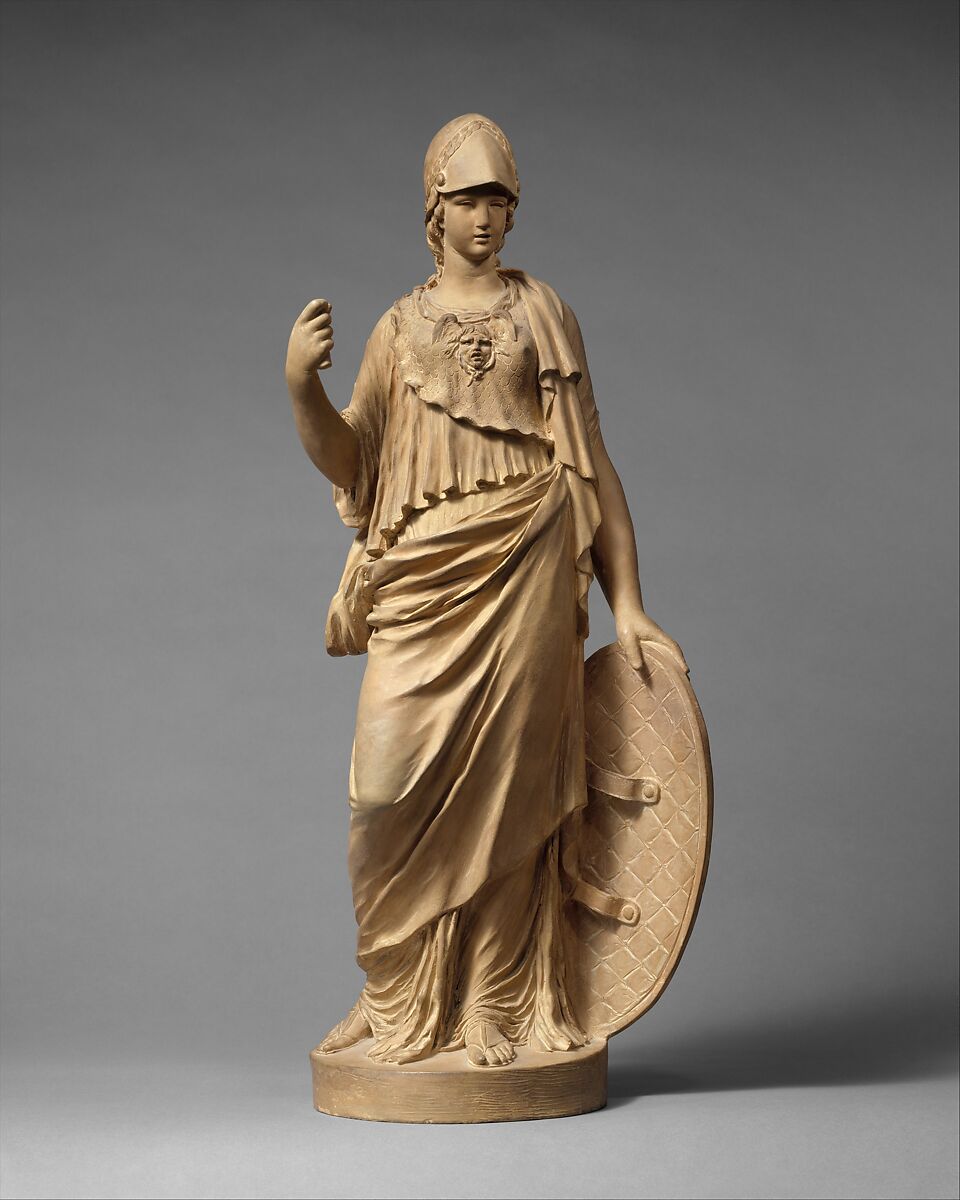
Minerva belongs to the Roman pantheon. Through her association with the Greek Athena, she brings together wisdom, skill in the arts and crafts, and armed strength. To see her only as a quiet guardian of knowledge is to overlook part of her history: helmet and shield belong to her image as much as the ability to understand and create.[1][8]
This combination gives the figure a lasting resonance. Knowledge appears as a foundation for skilled action. It would, however, be anachronistic to read a modern scientific method directly into this ancient symbolism.
Understanding
Wisdom connects knowledge with the ability to place it in context.
Making
The arts and crafts represent knowledge brought into practice through skill.
Judgment
The armed figure also evokes strategy, conflict and the exercise of power.
02 · The owl of Minerva
Look more closely.
Listen more carefully.
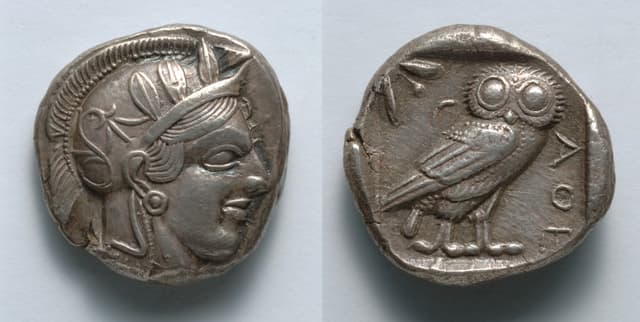
The association of Athena and the owl is visible on ancient coins: the goddess on one side, her bird on the other. The Athenian tetradrachm carried this image far beyond the city.[9] For MINERVA, we draw on the motif as an image of attentive research.
| An owl’s ability | Our interpretation for MINERVA |
|---|---|
|
Seeing in low light
Many owls have vision adapted to dim light.[10] |
Follow up on less obvious clues.
A footnote, an inconspicuous registry change or an older original document may open a new line of inquiry. A clue becomes evidence through examination. |
|
Locating sounds
The facial disc gathers sound; in some species, asymmetrical ears help locate its source.[10] |
Establish where a claim comes from.
Who reports first-hand, who cites, and who repeats? The origin of information matters more than how loudly or often it is shared. |
|
Seeing depth
Overlapping fields of vision help owls judge distance.[10] |
Compare different perspectives.
A company statement, a research paper and a regulatory document may illuminate different aspects of the same event. Discrepancies are a reason to ask further questions. |
03 · Reception
Across centuries.
For different purposes.
Artists, patrons, libraries and research organisations have each interpreted Minerva anew. Their images also reveal who wished to associate themselves with knowledge and wisdom.
Renaissance · Art & patronage
A figure open to interpretation
Botticelli’s Pallas and the Centaur belonged to Lorenzo di Pierfrancesco de’ Medici. Even the identity of the female figure is uncertain: the Uffizi suggest Pallas Athena, or Minerva, but also the warrior Camilla. The painting shows why apparently familiar symbols still require careful interpretation.[3]
Baroque · Patronage & power
Wisdom in an image of authority
For the Palazzo Medici Riccardi, Luca Giordano devised a fresco cycle in which wisdom and virtue also glorify the Medici. Minerva gives the key of knowledge to Intellect and a hammer to Craftsmanship. Learning and skill become part of a powerful family’s self-presentation.[4]
Enlightenment · The Illuminati order
The owl as a promise of education
Adam Weishaupt founded the Illuminati order in Ingolstadt in 1776. The society used the owl as its symbol and organised members in Minerval classes. Education and freedom from intellectual tutelage were among its aims; hierarchy, observation and reports to superiors also shaped the organisation.[11]
The tension is revealing: independent thought can be upheld as an ideal yet constrained by an organisation’s practices. For MINERVA, we take this as a reason to make evidence and reasoning accessible, enabling readers to exercise their own judgment.
Public library · Organising knowledge
A guardian of collected learning
In the Library of Congress’s Thomas Jefferson Building, Elihu Vedder’s Minerva studies a scroll listing fields of learning, including law, statistics and philosophy. Her helmet and shield are set aside; she retains her spear. The Library describes her as the Minerva of Peace and guardian of civilisation.[5]
Research organisations · Institutional identity
An emblem for science
The head of Minerva became the trademark of the Kaiser Wilhelm Society in 1926 and was adopted by the newly founded Max Planck Society in 1948. The predecessor organisation had used depictions of Minerva since 1911. This visual history reflects both continuity and a changing, later less martial image.[6]
04 · Philosophy
When does understanding begin?
One especially influential interpretation comes from Georg Wilhelm Friedrich Hegel. In the preface to his Philosophy of Right, dated 25 June 1820 (title-page year 1821), Minerva’s owl becomes an image of philosophical understanding.[7]
“The owl of Minerva, takes its flight only when the shades of night are gathering.”G. W. F. Hegel · Philosophy of Right, Preface · 1820/1821
Translation: S. W. Dyde, 1896
The image belongs to Hegel’s account of philosophy as its own time grasped in thought. A historical form becomes intelligible as it matures. Dusk points to understanding that comes afterwards; it offers no promise of foreseeing events.[7]
Looking back reveals connections.
Some conditions, turning points and consequences only become apparent with distance.
The future remains open.
Learning from history provides orientation. Forecasts still depend on assumptions and remain uncertain.
05 · Knowledge & judgment
What can we know?
And what grounds our judgments?
The owl leads to questions that extend far beyond its history as a symbol. Four philosophical perspectives help us sharpen our approach to research. Their connection to MINERVA is our own selection and interpretation.
Aristotle Recognise the limits of your own view.
In the Metaphysics, Aristotle compares human understanding of what is naturally most evident to the eyes of bats in daylight. His comparison draws attention to the possibility that a difficulty in knowing may lie in the observer.[12]
For our work: Examine the limits of the available data and your own position as an observer. Lack of visibility is not proof of non-existence.
Metaphysics II.1 · 993bFrancis Bacon Learn to question your own convictions.
Bacon’s Novum Organum describes “idols” as obstacles to understanding. He examines the power of ill-defined words and the tendency to seek support for established beliefs while discounting contrary examples.[13]
For our work: Clarify terms and actively look for conflicting evidence. A preferred explanation must remain open to scrutiny.
Novum Organum · Book I, aphorisms XXXIX–XLVI · 1620David Hume Distinguish experience from certainty.
Hume asks what justifies the move from past experience to expectations of future events. A pattern’s regularity in the past does not, by itself, prove that it must continue.[14]
For our work: Treat historical patterns as expectations requiring justification. Make assumptions, time horizons and possible changes explicit in forecasts.
An Enquiry Concerning Human Understanding · Sections IV–V · 1748Immanuel Kant Organise observations. Think for yourself.
In the Critique of Pure Reason, Kant connects cognition with the interaction of sensory intuition and concepts.[16] His essay on Enlightenment calls for the courage to use one’s own understanding and for freedom in the public use of reason.[15]
For our work: Use clear concepts to make information intelligible and disclose the reasoning behind an interpretation. Readers retain responsibility for their own judgment.
Critique of Pure Reason · A51/B75 · 1781/1787; What Is Enlightenment? · 1784For MINERVA, these perspectives suggest a working principle: observe carefully, clarify concepts, seek contrary evidence and acknowledge the limits of what we know.
06 · MINERVA at swarmalpha
A name that asks
something of our work.
MINERVA represents swarmalpha’s approach to researching and organising knowledge about information markets, prediction markets and the Forecast Economy. Original sources, scholarly work and historical context should help readers make sense of current developments.
We treat the name as a commitment. It has to be reflected in the work: traceable evidence, careful interpretation and a willingness to revise our own conclusions.
-
01
Go back to the source.
Find and examine original documents. Where they are unavailable, identify the secondary source used and the gap that remains.
-
02
Establish the context.
Connect a news item with its history, the people and organisations involved, and its subject matter. Repeated publication must not be mistaken for independent corroboration.
-
03
Respect the differences.
Distinguish terms, products and metrics carefully. Compare similar-sounding claims only when their periods, measures and scope are compatible.
-
04
Keep uncertainty visible.
Separate established facts, interpretations and open questions. Consider conflicting evidence and make revisions traceable.
-
05
Enable independent judgment.
Show the path from source to interpretation. Readers should be able to examine conclusions, challenge them and connect them with further findings.
At swarmalpha, MINERVA expresses a commitment to making information a foundation for informed, reasoned judgment.
We aim to build a body of knowledge that makes sources accessible, explains connections and reveals its own limits. Its value lies in how well it helps people conduct their own research, weigh evidence and make decisions.
Sources & context
Selected examples from a multifaceted history of reception. The historical account draws on the texts and collection records below. Its application to swarmalpha expresses our own commitment and implies no institutional affiliation with the organisations mentioned.
-
The Metropolitan Museum of Art ↗
Clodion, Minerva, 1766 · Object 1975.312.6 -
The Roman Baths ↗
Minerva’s head · Sulis Minerva, Bath -
Gallerie degli Uffizi ↗
Sandro Botticelli, Pallas and the Centaur, c. 1482 -
National Gallery, London ↗
Luca Giordano, Minerva as Protectress of the Arts and Sciences, early 1680s -
Library of Congress ↗
Great Hall · Minerva; Design for Minerva Congressional Library -
Max-Planck-Gesellschaft ↗
A logo and its history · Christina Beck, 11 April 2023 -
G. W. F. Hegel ↗
Philosophy of Right · Preface, 25 June 1820; English translation S. W. Dyde, 1896 -
Galleria Borghese ↗
Statue of Athena · Jessica Clementi, May 2022 -
Cleveland Museum of Art ↗
Tetradrachm: Head of Athena (obverse); Owl (reverse), 449–407 BCE · 1916.992 · Open Access -
Owl Research Institute ↗
Owl Adaptations · Vision, hearing and binocular vision -
Zentrum Stadtgeschichte Ingolstadt · Beatrix Schönewald ↗
Illuminaten · Stadtgeschichtslexikon, 2024 -
Aristotle / Aristoteles ↗
Metaphysics II.1, 993b · W. D. Ross translation · MIT Internet Classics Archive -
Francis Bacon ↗
Novum Organum, Book I, aphorisms XXXIX–XLVI · 1620 · Project Gutenberg -
David Hume ↗
An Enquiry Concerning Human Understanding, Sections IV–V · 1748 · Project Gutenberg -
Immanuel Kant ↗
Beantwortung der Frage: Was ist Aufklärung? · 1784 · German History in Documents and Images -
Immanuel Kant ↗
Kritik der reinen Vernunft · A51/B75 · Akademie-Ausgabe III, p. 75 · Korpora